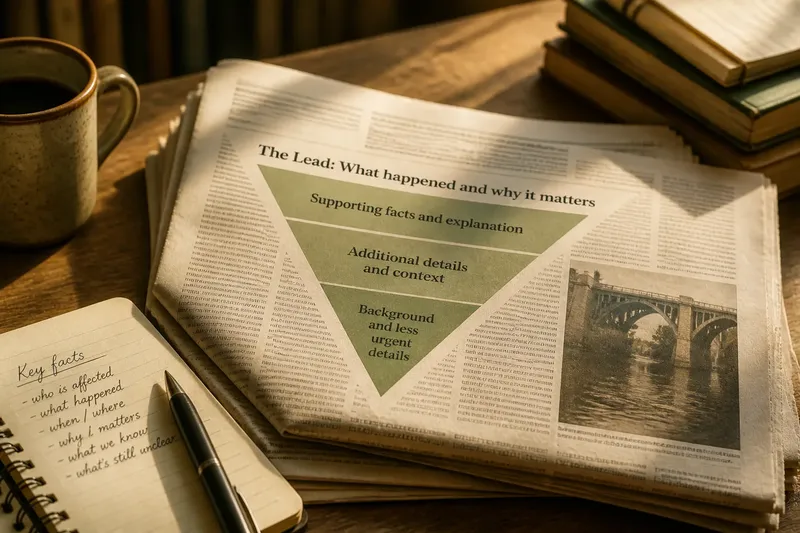
A Sunday Reading Session for One Developing Story
A Sunday reading session for a developing story helps you date each claim, see what changed during the week, and keep unanswered questions visible.
What did this developing story actually establish this week, and what is still only being suggested? A Sunday reading session for a developing story gives you a calm way to answer that without turning every new alert into a fresh verdict. The aim is a dated record: what a report said, what later reporting changed, and which questions remain open.
Choose one story that has produced several updates: a public investigation, a disputed policy decision, or a natural event whose effects are still being assessed. Keep the session to a manageable stretch of time and use a notebook, a plain-text document, or a spreadsheet. The format matters less than the habit of dating each entry and preserving the wording of claims.
Set up a record that can change without erasing its past
Start with a short heading that identifies the story in neutral terms, followed by the date of the session. Avoid a title that already settles the dispute. “City review of water service” is easier to maintain than “Officials conceal water failure,” unless concealment has itself been established and is the subject of the record.
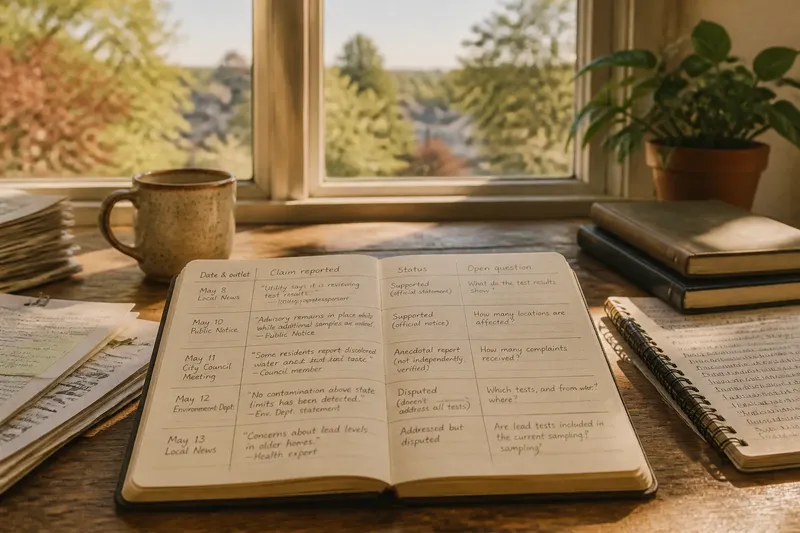
Make four columns or recurring labels:
- Date and outlet: When you read it and where it appeared.
- Claim reported: The specific statement, attributed to its source where possible.
- Status: What is supported, disputed, corrected, or still unclear.
- Open question: What evidence or answer would clarify the point.
Use the date you read an item as well as the publication date if those differ. A page may be updated after its first publication; note “updated” when the outlet marks it, and preserve the earlier wording only if you have a reliable record of it. Do not reconstruct an old version from memory.
Keep claims small enough to evaluate. “The department says it received complaints” is a different claim from “the department ignored complaints.” One reports an assertion about receipt; the other adds a judgment about response. Splitting them prevents a source’s words, a reporter’s interpretation, and your own inference from blending together.
Use the week to collect changes, not every mention
During the week, you do not need to track every headline or notification. Save items that add a distinct piece of evidence, correct a prior account, introduce a relevant source, or materially revise the story’s scope. A second article that repeats the same statement may be useful for comparison, but it does not automatically create a new fact.
When an update catches your attention, make a brief note in the moment: date, link or outlet, and the claim that appears new. If you cannot tell what changed, write that down instead of filling the gap with an assumption. The Sunday session is where you compare the item with the record, not where you have to make an immediate judgment.
Say you are following a report about a town’s temporary water advisory. On Wednesday, a local outlet quotes the utility saying it is reviewing test results; on Friday, a public notice says the advisory remains in place while additional samples are collected. Your notes should not turn “reviewing” into “results are safe,” or “additional samples” into proof of danger. Record each statement with its source, then leave the underlying result as an open question until a relevant record or attributed update addresses it.
Read the Sunday record in a fixed order
Begin by reviewing your notes before opening a new search. This guards against letting the latest alert silently replace what you knew earlier. Read each entry and ask whether it is a claim, a piece of evidence, a correction, or an interpretation. Mark the distinction plainly.
Then open the original items where practical. Check the headline against the body, the date, the named source, and any linked document. If a report cites a filing, announcement, public notice, or transcript, inspect that source when it is available. A primary document can establish what it says; it may not establish whether the statement in it is complete or independently verified.
Next, compare the week’s entries. Look for changes in attribution, scope, and certainty. Did a claim first appear as an allegation and later become a confirmed finding? Did an early report describe one location, while a later account broadened the area? Did an outlet correct a name, date, or central detail? Write the change as a dated update rather than silently editing the original entry.
Finally, give each open question a status that reflects the record, not your preference. Useful labels include “answered by a cited document,” “addressed but disputed,” “not addressed in the sources reviewed,” and “unclear because accounts conflict.” These labels are not verdicts about the whole story. They describe what your collected material can currently support.
Keep evidence, claims, and uncertainty in separate lanes
A source can be credible about one thing and limited about another. A public agency may be a direct source for its own advisory; it may not be an independent evaluator of whether its response was adequate. A witness can describe what they saw, while lacking access to records that explain why it happened. Preserve that boundary in your notes by writing who said what and what kind of access they appear to have.
When accounts conflict, do not average them into a middle position. Record the competing statements and identify what could distinguish them: a dated document, a named measurement, a full recording, or a response from the party being described. If that evidence is not available, the conflict remains part of the story’s current state.
Keep a separate line for your own inference. For example: “I suspect the advisory may last longer because sampling is continuing” is an inference, not a reported fact. Naming it as such makes it easier to revise without changing the underlying record.
What should you do when the story changes?
Should I replace an earlier note when a report is corrected?
Keep the dated entry and add a correction beneath it, including what changed and which outlet made the change. That preserves the trail while making the current account easy to identify.
What belongs in the record if two sources disagree?
Write each source’s specific claim with its attribution, then note the point of disagreement. Add what evidence would help resolve it, but do not treat the more familiar or confident-sounding account as settled on that basis alone.
How do I handle a question nobody has answered yet?
Write it as a question and mark it unresolved, along with the type of source that might answer it. If the question remains unanswered next Sunday, carry it forward without treating its persistence as evidence for either side.
When should I stop following the story?
Pause when updates are repeating known claims without adding evidence, correcting the record, or changing the stakes. You can resume if a concrete new development appears; attention does not have to be continuous for the notes to remain useful.
Close the session with a short dated account
At the end, write a few sentences that answer three questions: What is currently supported by the material you reviewed? What changed this week? What remains unknown or disputed? Attribute claims in the first sentence rather than presenting a source’s assertion as a settled fact. Keep the note private or share it with someone else only if its limits are clear.
End with the next useful signal to watch for, such as publication of a named document, a formal response, or a correction to a specific claim. Avoid predicting when it will arrive. If nothing new appears, that is a reason to leave the record untouched, not to manufacture an update.
A Sunday reading session for a developing story works best as a record of changing knowledge, not a machine for producing certainty. A dated list lets you see how the account evolved while keeping gaps visible. The most useful note may be the one that says exactly what you still cannot tell.